 fsd_wiki
Luyten
Amongst those Systems that suffered such complete isolation in the Schism, Luyten was typical of the mid-era colonisation expansion. After the Singularity, the Hive AI did not wipe out the population but dealt major losses to the humans, and though initially driven from the system by the humans’ resistance, the terrifying prospect of their legacy lives on.
Hushed rumours talk of caches of dormant Tech forces, hidden in vaults and old, forgotten structures across the moons and wild, undiscovered areas of Luyten’s planets.
Humanity’s basic drives and motivations had not changed though. Despite millennia of technolological advancement and sociological progression, the need for power and control over resources and people were once again revealed as people suffered the hardships of their lives after the Schism.
Many different factions rose up to gain control of the system’s resources: none have yet prevailed. Despite some Nations and Corporations laying claim to a moon or a continent, most of the System is still contended; conflict abounds.
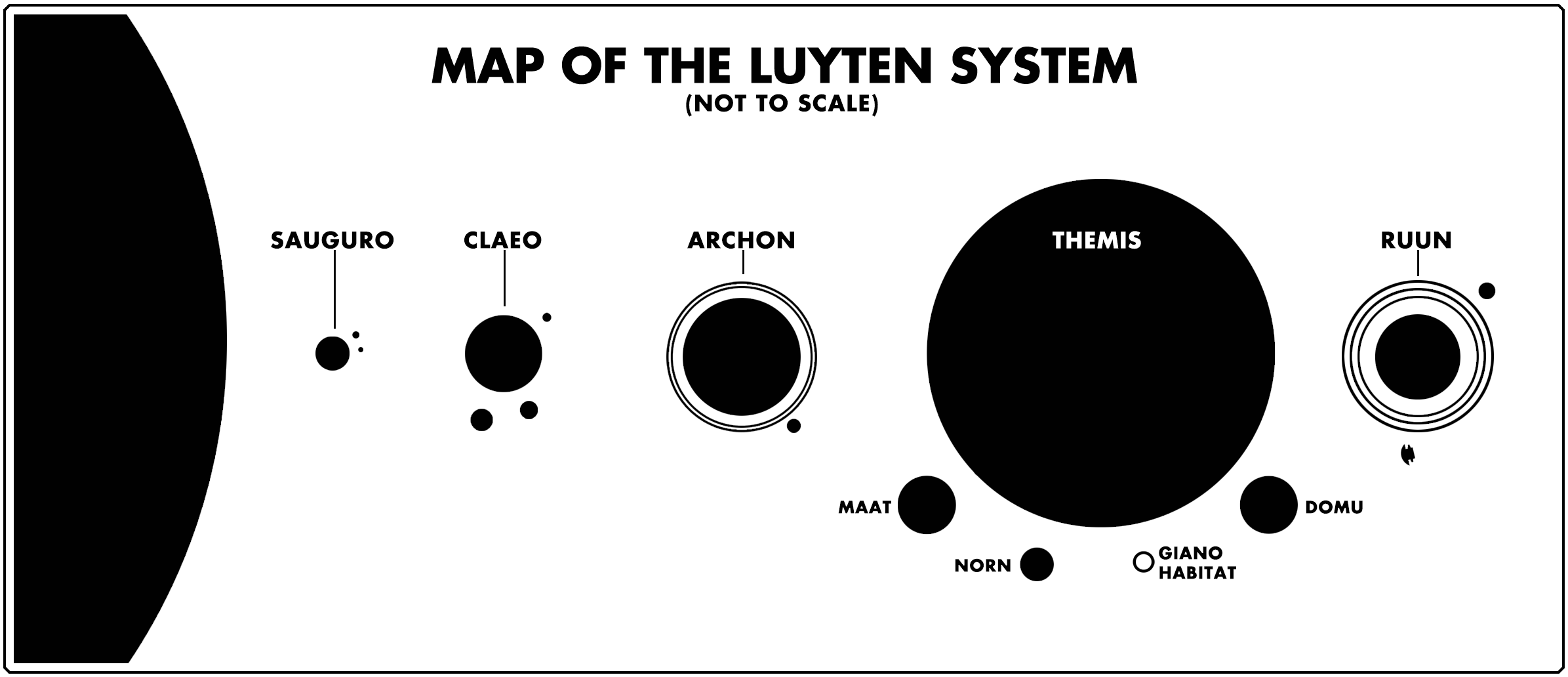
The Inner System
Sauguro, the innermost planet, is mostly a barren rock which was terraformed in the years immediately preceding the Singularity and, despite the harshness of the conditions on the surface, still holds a breathable atmosphere.
Extremely rich in resources, especially those needed for the substrates used in computational matrices, it is a precious target for many who covet its hidden riches.
The planet is the native habitat of several species of animals, including fast and aggressive crab-like megafauna.
Claeo, or New Earth, is the only planet in the Luyten system with both a natural atmosphere and liquid water. On its surface there are a plethora of biomes, and some indigenous flora and fauna. This jewel in the Luyten system is coveted by many for its rich, fertile lands, and spark fierce competition among would-be rulers.
The three moons of Claeo act as spaceports and host a handful of relatively small but teeming settlements.
Archon is a rocky planet with a double ring and higher gravity, and it was an early subject of the colonial terraforming programme,.
It is now covered in cunningly geo-engineered pseudo-vegetation, that provides atmosphere and temperature control within tolerable limits at the planetary surface.
Archon is subject to highly active geological mantle activity, and the resulting violent plate tectonics have created sharp and convoluted features throughout the its surface.
The only moon of a considerable size is constantly hit by dust and small asteroids coming from the planet’s preparedrings and is almost entirely uninhabited.
The Outer System
Themis is a gas giant, around which there are three inhabited moons: Domu, Maat and Norn. The planet also marks the beginning of the outer regions of the System, with a much lower density of asteroids and comets.
Themis has a dense Hydrogen and Helium atmosphere, with strong convective currents which are exploited by numerous harvesters to extract cheap deuterium.
Domu is a rocky moon and has the largest population among the moons of Themis. Their inhabitants have lived there for over six generations, and have been genetically engineered to be able to withstand the high level of hydrocarbons in the air.
Norn is a small arid planet, closer to Themis and with a very high internal temperature due to the tidal forces. It was hit harder during the Schism, and most of its factory-cities are now not operational, with only small groups of survivors living in them, shielded by the external atmosphere that returned to toxic levels once most of the terraforming facilities got destroyed.
Maat is a much colder moon, almost entirely covered in a sea of liquid methane. There are still two operational deuterium harvesters floating on the surface, each harbouring a small community living both inside and in small fleets of vessels following them in their long harvesting cycles.
The Giano Habitat, he only fully functioning habitat of the System, follows Themis in its L1 Lagrangian orbit, away from any disturbance that the moons could provide. It is considerably smaller than any of the other moons of Themis, but its dense population and high tech industrial output makes it a location equally as relevant for anyone travelling in the Outer System.
Ruun, the outermost planet of the Luyten system, is a cold and desolate planet with an unusual level of active geothermal activity. This geothermal activity results in vast dust storms, shot through with extreme electrical discharges and deafening thunder. An awe-inspiring sight to be sure, though this extreme weather makes human habitation extremely difficult on the surface.
Most of the surface water present was a result of terraforming, and has since frozen on the surface, though beneath this permafrost crust are warmer, more temperate waters, kept tolerable by the activity of hydrothermal vents.
It is not clear to the humans who inhabit Ruun what life might exist in these underwater havens.